



ESD anti-fatigue mats are designed for workplaces where standing comfort and static control are both important. They help support workers who stand for long periods while also helping protect operatives, sensitive equipment and electronic components from electrostatic discharge.
Two very similar options available from Mats4U are the Deckplate Anti-Static ESD Anti Fatigue Mat and the Senso Dial ESD Anti Fatigue Mat. Both are designed for static-sensitive work areas, both provide standing comfort, and both are suitable for workplaces handling sensitive electronics.
The main difference is the construction and duty level. Deckplate Anti-Static is the thicker 14mm dry indoor industrial mat with a conductive vinyl top surface, PVC foam backing and a 10mm male stud for grounding. Senso Dial is a 10mm ESD anti-fatigue mat with an SBR/NBR rubber top surface and EPDM foam base, making it a practical option for static-safe workstations, high-traffic areas and larger roll layouts.
Table of Contents
- Why Compare Deckplate Anti-Static and Senso Dial?
- Quick Comparison: Deckplate Anti-Static vs Senso Dial
- What Is the Deckplate Anti-Static ESD Anti Fatigue Mat?
- What Is the Senso Dial ESD Anti Fatigue Mat?
- ESD Protection and Static Control
- Anti-Fatigue Comfort Comparison
- Diamond Pattern vs Deckplate Pattern
- Vinyl and PVC Foam vs Rubber and EPDM Foam
- Thickness, Profile and Edge Design
- Size and Roll Options
- Workplace Suitability
- Cleaning and Maintenance
- Product Comparison: Deckplate Anti-Static and Senso Dial
- Which One Should You Choose?
- Where to Use ESD Anti-Fatigue Mats
- Frequently Asked Questions
Why Compare Deckplate Anti-Static and Senso Dial?
Deckplate Anti-Static and Senso Dial are worth comparing because they are both ESD anti-fatigue mats. This means they are designed for environments where static control is important, but where workers also need relief from standing on hard floors for long periods.
They are both suitable for workstations, production areas, assembly points and other static-sensitive spaces. However, they are not identical. Deckplate Anti-Static has a heavier 14mm construction with a conductive vinyl top surface. Senso Dial is a 10mm rubber and foam ESD mat with softer backing and more roll-style layout options.
Both Are Designed for Static-Sensitive Areas
Both products are made for environments where electrostatic discharge could damage sensitive equipment, electronic parts or components.
Both Provide Anti-Fatigue Support
Both mats help reduce discomfort for workers who stand for extended periods during assembly, production, inspection or technical work.
Both Have Textured Surfaces
Both mats have patterned surfaces that help improve grip underfoot and create a more practical standing area.
Different Construction
Deckplate Anti-Static uses a vinyl top surface with PVC foam backing. Senso Dial uses an SBR/NBR rubber top surface with an EPDM foam base.
Quick Comparison: Deckplate Anti-Static vs Senso Dial
The table below gives a simple overview of how the two ESD anti-fatigue mats compare.
| Feature | Deckplate Anti-Static ESD Anti Fatigue Mat | Senso Dial ESD Anti Fatigue Mat |
|---|---|---|
| Best For | Dry indoor static-sensitive industrial workstations needing a thicker anti-fatigue mat | Static-safe workstations, electronic areas and larger ESD matting layouts |
| Mat Type | Conductive ESD anti-fatigue mat | ESD anti-fatigue mat with rubber top and foam base |
| Top Surface | Conductive vinyl top surface | SBR/NBR rubber top surface |
| Backing/Base | PVC foam backing, fusion bonded | EPDM foam base |
| Surface Finish | Diamond pattern | Deckplate pattern |
| Product Height | 14mm | 10mm |
| ESD Testing | EN14041 resistance requirements, Rv of 9.8 x 10⁷ Ω | IEC 61340-4-1, Rp-p and Rg less than 1 x 10⁹ Ω |
| Grounding | 10mm male stud fitted to the mat | Designed for static discharge in ESD-safe workspaces |
| Size Options | Standard sizes, rolls and linear metre options | Standard sizes, 10m rolls and linear metre options |
| Main Advantage | Thicker conductive dry-area mat with strong ESD and chemical-resistance features | Softer rubber and foam ESD mat with flexible workstation and roll options |
What Is the Deckplate Anti-Static ESD Anti Fatigue Mat?
The Deckplate Anti-Static ESD Anti Fatigue Mat is a hardwearing anti-fatigue mat designed for dry indoor static-sensitive areas. It is made with a conductive vinyl top surface and PVC foam backing that is fusion bonded rather than glued.
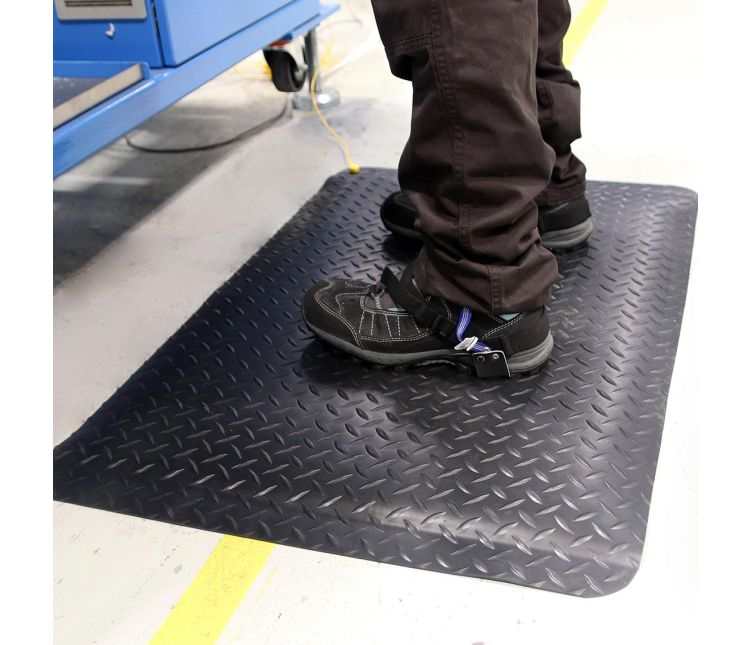
The mat is designed to protect both operatives and sensitive components from electrostatic discharge while also giving workers a more comfortable standing surface. It has a diamond pattern surface for grip and a 10mm male stud fitted for grounding.
Conductive Top Surface
The conductive top surface helps protect workers and sensitive components in static-sensitive areas. This makes the mat suitable for electronics workstations, assembly areas and technical spaces where ESD control is important.
Diamond Pattern Finish
The diamond pattern surface helps improve traction underfoot while giving the mat a professional industrial appearance.
14mm Product Height
At 14mm, Deckplate Anti-Static is the thicker mat in this comparison. This makes it a strong choice where more substantial anti-fatigue support is required.
Grounding Stud Included
The mat includes a 10mm male stud, allowing a suitable grounding connection to be made as part of a static-control setup.
What Is the Senso Dial ESD Anti Fatigue Mat?
The Senso Dial ESD Anti Fatigue Mat is a durable anti-fatigue mat designed for workspaces where sensitive electronic equipment must be protected from static discharge. It has an SBR/NBR rubber top surface and an EPDM foam base.
The mat is 10mm high and has a deckplate pattern surface for grip. It is designed to provide ESD protection, standing comfort and a safer working surface in busy static-sensitive areas.
Rubber Top Surface
Senso Dial has an SBR/NBR top surface. This gives it a practical rubber finish for standing workstations and high-traffic static-safe areas.
EPDM Foam Base
The EPDM foam base provides cushioning for workers who stand for extended periods, helping reduce discomfort during long shifts.
10mm Product Height
At 10mm high, Senso Dial has a lower profile than Deckplate Anti-Static. This can be helpful in areas where a slimmer ESD mat is preferred.
Flexible Size Options
Senso Dial is available in standard workstation sizes, linear metre options and 10m rolls, making it useful for both individual standing stations and longer ESD-safe floor areas.
ESD Protection and Static Control

The main reason to choose either of these mats is static control. In areas where electronics, components or sensitive equipment are handled, electrostatic discharge can be a serious problem.
Deckplate Anti-Static ESD Protection
Deckplate Anti-Static is designed with a conductive top surface and is tested to meet EN14041 resistance requirements. It is listed with a resistance value of 9.8 x 10⁷ Ω.
Senso Dial ESD Protection
Senso Dial is listed with Rp-p and Rg measurements of less than 1 x 10⁹ Ω in line with IEC 61340-4-1. This supports efficient static discharge in static-safe work areas.
Which Has the Lower Listed Resistance Value?
Deckplate Anti-Static has the lower listed resistance value in this comparison, with an Rv of 9.8 x 10⁷ Ω.
Which Uses IEC 61340-4-1 Testing?
Senso Dial is the mat listed with Rp-p and Rg measurements in line with IEC 61340-4-1.
Anti-Fatigue Comfort Comparison
Both mats are designed to support workers who stand for long periods, but their comfort comes from different constructions.
Deckplate Anti-Static Comfort
Deckplate Anti-Static uses PVC foam backing beneath a conductive vinyl top surface. This gives the mat anti-fatigue support while maintaining a durable top surface for dry industrial use.
Senso Dial Comfort
Senso Dial uses a soft EPDM foam base beneath an SBR/NBR rubber surface. This makes it a practical anti-fatigue option for workers in static-safe environments.
Which Is Thicker?
Deckplate Anti-Static is thicker at 14mm, while Senso Dial is 10mm high.
Which Is Lower Profile?
Senso Dial is the lower-profile option, which can be useful where a slimmer workstation mat is preferred.
Diamond Pattern vs Deckplate Pattern
The surface pattern affects grip, appearance and the way the mat feels underfoot.
Deckplate Anti-Static Diamond Pattern
Deckplate Anti-Static has a diamond pattern surface. This gives the mat a traditional industrial look and helps improve slip resistance in dry indoor work areas.
Senso Dial Deckplate Pattern
Senso Dial has a deckplate pattern surface. This textured rubber surface provides grip and supports safer footing in busy workspaces.
Which Looks More Industrial?
Both mats have an industrial appearance, but Deckplate Anti-Static has the more traditional black diamond-pattern finish.
Which Is Better for General Grip?
Both surfaces are designed to support grip underfoot. Choose based on the required material, height and ESD specification rather than surface appearance alone.
Vinyl and PVC Foam vs Rubber and EPDM Foam

The material is one of the clearest differences between these mats.
Deckplate Anti-Static Material
Deckplate Anti-Static has a vinyl top surface with PVC foam backing. The layers are fusion bonded, not glued, which supports durability in dry industrial conditions.
Senso Dial Material
Senso Dial has an SBR/NBR top surface with an EPDM foam base. This gives it a rubber top with cushioned foam support underneath.
Which Has a Conductive Vinyl Surface?
Deckplate Anti-Static has the conductive vinyl top surface.
Which Has a Rubber Top Surface?
Senso Dial has the SBR/NBR rubber top surface.
Thickness, Profile and Edge Design
Thickness and edge design can affect comfort, placement and safety around the workstation.
Deckplate Anti-Static Profile
Deckplate Anti-Static is 14mm high, giving it a thicker anti-fatigue profile. This makes it suitable for dry indoor areas where comfort and ESD protection are both required.
Senso Dial Profile
Senso Dial is 10mm high and includes ramped edges to reduce trip risks. This makes it a practical option for busy work areas where people may step on and off the mat regularly.
Which Has Ramped Edges?
Senso Dial is listed with smartly engineered ramped edges to help reduce trips.
Which Has More Cushioned Height?
Deckplate Anti-Static has more height, making it the more substantial option underfoot.
Size and Roll Options
Size options matter because ESD matting may be needed for one workstation, several workstations or a longer production line.
Deckplate Anti-Static Size Options
- 60cm x 90cm
- 90cm x 150cm
- 90cm x 1830cm
- 120cm x 1830cm
- 90cm x per linear metre
- 120cm x per linear metre
Senso Dial Size Options
- 60cm x 100cm
- 100cm x 150cm
- 100cm x 10m
- 120cm x per linear metre
- 100cm x per linear metre
- 120cm x 10m
Which Offers Longer Rolls?
Both products offer roll-style coverage, but Senso Dial clearly lists 10m roll options in 100cm and 120cm widths.
Which Is Better for Larger Dry Static-Safe Areas?
Deckplate Anti-Static is strong for larger dry static-sensitive areas where a thicker conductive mat is needed, especially with 90cm and 120cm roll options.
Workplace Suitability

Both mats are designed for ESD workplaces, but the best choice depends on the specific working conditions.
Deckplate Anti-Static Workplace Suitability
Deckplate Anti-Static is suitable for dry indoor environments where workers need static protection, anti-fatigue support and a resilient top surface. It is a strong option for electronics assembly, component handling and dry industrial workstations.
Senso Dial Workplace Suitability
Senso Dial is suitable for static-safe workspaces where a rubber top surface, foam base and lower profile are preferred. It is useful for workstations, assembly areas and areas dealing with sensitive electronic equipment.
Which Is Better for Dry Industrial Areas?
Deckplate Anti-Static is the better choice for dry industrial areas where a thicker mat and conductive vinyl surface are preferred.
Which Is Better for Flexible Workstation Layouts?
Senso Dial is a strong choice for flexible workstation layouts because it offers standard sizes, linear metre options and 10m rolls.
Cleaning and Maintenance
ESD mats should be kept clean so they continue to provide a safe and effective standing surface. Dirt, dust and contamination can affect the way any mat performs over time.
Cleaning Deckplate Anti-Static
Deckplate Anti-Static should be kept clean in dry indoor areas. Sweep or vacuum loose dirt regularly and wipe the surface with a suitable damp cloth or mild cleaning solution as required.
Cleaning Senso Dial
Senso Dial should also be swept, vacuumed or wiped clean regularly to remove dust and dirt. Avoid harsh cleaners unless they are confirmed as suitable for the mat material and the ESD environment.
Check Grounding Setup
Where a grounding stud or grounding accessory is used, the connection should be checked as part of routine workplace safety and ESD control checks.
Maintenance Tip
Inspect ESD anti-fatigue mats regularly for damage, curled edges, worn surfaces or poor floor contact. Replace any mat that no longer lies flat or no longer supports safe use.
Product Comparison: Deckplate Anti-Static and Senso Dial
The following two Mats4U products are very similar ESD anti-fatigue mats, making them ideal for a direct comparison.

Which One Should You Choose?
The easiest way to choose between Deckplate Anti-Static and Senso Dial is to look at the required material, height and layout. If you need a thicker dry indoor mat with a conductive vinyl surface, choose Deckplate Anti-Static. If you need a lower-profile rubber and foam ESD mat with roll and linear metre options, choose Senso Dial.
Choose Deckplate Anti-Static ESD Anti Fatigue Mat If:
- You need a hardwearing ESD anti-fatigue mat for dry indoor areas.
- You want a conductive vinyl top surface.
- You need a 14mm anti-fatigue mat.
- You prefer a diamond pattern surface.
- You need a 10mm male grounding stud fitted to the mat.
- You need a mat tested to EN14041 resistance requirements.
- You want limited resistance to chemicals and oils.
- You need 90cm or 120cm roll or linear metre options.
- The mat will be used in electronics, assembly or static-sensitive industrial areas.
Choose Senso Dial ESD Anti Fatigue Mat If:
- You need an ESD anti-fatigue mat with a rubber top surface.
- You want an SBR/NBR surface with an EPDM foam base.
- You prefer a lower 10mm mat height.
- You need ramped edges to help reduce trip risks.
- You want standard sizes as well as 10m roll options.
- You need a mat listed to IEC 61340-4-1 measurements.
- You want Rp-p and Rg measurements of less than 1 x 10⁹ Ω.
- You need a flexible matting option for individual workstations or longer ESD-safe areas.
- You want a soft foam backing for fatigue relief.
The Simple Answer
Choose Deckplate Anti-Static for a thicker dry indoor ESD mat with conductive vinyl surface, diamond pattern and fitted grounding stud. Choose Senso Dial for a lower-profile rubber and foam ESD mat with ramped edges, roll options and flexible workstation coverage.
Where to Use ESD Anti-Fatigue Mats

ESD anti-fatigue mats are used in areas where static discharge could affect sensitive parts, equipment or production quality. They are most useful where workers stand for long periods while handling electronics or technical components.
Electronics Assembly Areas
Both mats are suitable for electronics assembly areas. Deckplate Anti-Static is the stronger choice where a thicker conductive vinyl mat is needed, while Senso Dial is useful where a rubber and foam option is preferred.
Component Handling Stations
ESD mats are useful at component handling stations where static discharge needs to be controlled and staff may stand in one position for long periods.
Production Lines
Senso Dial is a strong option for production lines because it is available in roll and linear metre options. Deckplate Anti-Static can also be used where a thicker dry-area mat is required.
Testing and Inspection Areas
Both mats can support testing and inspection areas where workers need comfort and static-safe flooring around equipment.
Technical Workbenches
Use ESD anti-fatigue mats near technical workbenches where staff move between standing tasks and sensitive equipment handling.
Repair Workshops
Both mats can be used in repair workshops where electronic parts, devices or instruments need extra static protection.
Dry Industrial Workstations
Deckplate Anti-Static is better for dry industrial workstations because it is specifically listed for dry indoor environments and has a thicker 14mm profile.
Larger Static-Safe Areas
Senso Dial is useful for larger static-safe floor areas because it offers 10m roll options and linear metre choices.
Frequently Asked Questions
Q1: What is the difference between Deckplate Anti-Static and Senso Dial?
A1: Deckplate Anti-Static has a conductive vinyl top surface, PVC foam backing and 14mm height. Senso Dial has an SBR/NBR rubber top surface, EPDM foam base and 10mm height.
Q2: Are both mats designed for ESD protection?
A2: Yes. Both mats are designed for static-sensitive workplaces where electrostatic discharge control is important.
Q3: Which mat is thicker?
A3: Deckplate Anti-Static is thicker at 14mm. Senso Dial is 10mm high.
Q4: Which mat has a conductive vinyl top surface?
A4: Deckplate Anti-Static has the conductive vinyl top surface.
Q5: Which mat has a rubber top surface?
A5: Senso Dial has an SBR/NBR rubber top surface.
Q6: Which mat has PVC foam backing?
A6: Deckplate Anti-Static has PVC foam backing that is fusion bonded to the top surface.
Q7: Which mat has an EPDM foam base?
A7: Senso Dial has an EPDM foam base.
Q8: Which mat has a diamond pattern surface?
A8: Deckplate Anti-Static has a diamond pattern surface.
Q9: Which mat has a deckplate pattern surface?
A9: Senso Dial has a deckplate pattern surface.
Q10: Which mat has a grounding stud?
A10: Deckplate Anti-Static has a 10mm male stud fitted to the mat for grounding.
Q11: Which mat is tested to EN14041 resistance requirements?
A11: Deckplate Anti-Static is listed as tested to EN14041 resistance requirements.
Q12: Which mat is listed to IEC 61340-4-1?
A12: Senso Dial is listed with Rp-p and Rg measurements of less than 1 x 10⁹ Ω in line with IEC 61340-4-1.
Q13: Which mat is better for dry indoor industrial areas?
A13: Deckplate Anti-Static is better for dry indoor industrial areas where a thicker conductive mat is needed.
Q14: Which mat is better for longer workstation layouts?
A14: Senso Dial is a strong option for longer workstation layouts because it is available in linear metre and 10m roll options.
Q15: Which mat has ramped edges?
A15: Senso Dial is listed with ramped edges that help reduce trip risks.
Q16: Which mat offers limited chemical and oil resistance?
A16: Deckplate Anti-Static is listed with a PVC top surface that provides limited resistance to chemicals and oils.
Q17: Can these mats help reduce standing fatigue?
A17: Yes. Both mats are anti-fatigue mats designed to support workers who stand for extended periods.
Q18: Can these mats protect sensitive components?
A18: Yes. Both mats are designed for static-sensitive environments where sensitive components and equipment require ESD protection.
Q19: How should ESD anti-fatigue mats be maintained?
A19: Keep the mat clean, remove dust and debris regularly, check that it lies flat, and inspect any grounding connections or accessories as part of routine ESD control checks.
Q20: Where can I buy Deckplate Anti-Static and Senso Dial ESD mats?
A20: Deckplate Anti-Static ESD Anti Fatigue Mat and Senso Dial ESD Anti Fatigue Mat are both available from Mats4U.


